
Quick answer
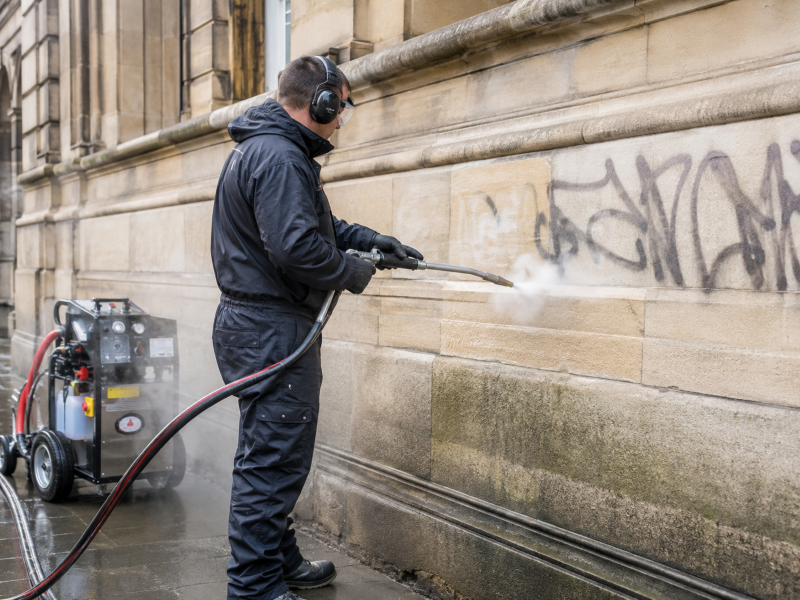
Graffiti cleaning on sensitive masonry should be planned carefully because brick, stone, lime mortar, heritage façades and porous surfaces can be damaged by aggressive cleaning methods. DOFF cleaning can support the process by using superheated steam at low pressure to help clean delicate surfaces without the harsh impact of high-pressure washing. For commercial building managers, councils, estates teams and property owners, the right approach depends on the surface type, graffiti material, level of staining, surrounding area and long-term presentation of the building.
Why sensitive masonry needs a careful graffiti cleaning plan
Graffiti on brick, stone and masonry is not only a visual problem. It can affect public perception, attract further vandalism and make an otherwise well-managed building look neglected.
However, sensitive masonry cannot always be cleaned in the same way as modern cladding, painted metal or hard external surfaces.
Older brickwork, natural stone, decorative masonry and heritage façades can be porous, fragile or weathered. If the wrong method is used, graffiti cleaning can leave behind surface damage, patch marks, staining, mortar loss or a cleaned area that looks visibly different from the surrounding wall.
For facilities managers and building managers the aim is not simply to remove the graffiti. The aim is to restore the surface as safely and evenly as possible.
That is why Deep Clean 24 Seven plans graffiti removal around the material, the setting and the long-term appearance of the building.
What makes graffiti cleaning on masonry more difficult?
Graffiti paint and ink can soak into porous materials. Once this happens, the staining may sit below the surface rather than simply resting on top of it.
This can make graffiti cleaning more complex on:
- Brickwork
- Natural stone
- Limestone
- Sandstone
- Granite
- Concrete
- Lime mortar
- Historic façades
- Boundary walls
- Public monuments
- Commercial entrance walls
If harsh pressure, unsuitable chemicals or abrasive tools are used, the surface may be marked or weakened. On sensitive buildings, this can create a bigger issue than the graffiti itself.
A professional approach starts with assessment, not force.
How DOFF cleaning supports graffiti cleaning
DOFF cleaning is often used on sensitive masonry because it uses superheated steam at low pressure.
This makes it suitable for many delicate external surfaces where aggressive pressure washing may not be appropriate.
When coordinated with graffiti cleaning, DOFF cleaning can help:
- Lift staining from porous surfaces
- Reduce reliance on high-pressure methods
- Clean surrounding masonry more evenly
- Support façade restoration
- Reduce surface damage risk
- Improve the appearance of weathered areas
- Remove algae, moss and atmospheric dirt alongside graffiti residues
- Support more controlled cleaning on heritage-style materials
The exact method still depends on the surface and the type of graffiti. Some graffiti may require specialist pre-treatment before steam cleaning, while other surfaces may need a more conservative cleaning process.
The key is to match the method to the masonry.
How to coordinate graffiti cleaning and DOFF cleaning
1 Identify the masonry type before work starts
The first step in any graffiti cleaning project is to understand the surface.
Brick, stone and concrete all respond differently to cleaning. Even within the same building, one elevation may be more weathered, porous or fragile than another.
A site assessment should consider:
- Surface material
- Age and condition
- Mortar condition
- Porosity
- Previous cleaning damage
- Paint type or ink type
- Depth of staining
- Surrounding public access
- Drainage and run-off control
- Access requirements
This helps the cleaning team decide whether DOFF cleaning, pre-treatment, low-pressure rinsing or a phased approach is most suitable.
2 Test a discreet area where possible
Sensitive masonry can react unpredictably.
Before full graffiti cleaning begins, a small test area can help confirm how the surface responds. This is especially useful on natural stone, historic brickwork, soft masonry or highly visible façades.
A test area helps identify:
- Whether staining can be lifted
- Whether shadowing remains
- Whether the surface changes colour
- Whether mortar is affected
- Whether further treatment is needed
- Whether DOFF cleaning is suitable
- Whether the surrounding masonry needs blending
For commercial building managers this reduces uncertainty before wider cleaning takes place.
3 Choose the right graffiti cleaning method
Not all graffiti should be treated in the same way.
Some paint sits on the surface. Some ink penetrates deeply. Some graffiti has been layered over older staining. Some walls have already been damaged by previous cleaning attempts.
Professional graffiti cleaning may involve:
- Surface assessment
- Controlled pre-treatment
- Dwell time management
- Careful agitation where suitable
- DOFF steam cleaning
- Low-pressure rinsing
- Repeat treatment for stubborn staining
- Final surface review
The aim is to remove as much graffiti as safely possible without causing unnecessary damage to the masonry.
On sensitive surfaces, patience usually gives a better result than aggressive cleaning.
4 Use DOFF cleaning to protect delicate surfaces
DOFF cleaning can be particularly useful when graffiti appears on masonry that also has dirt, algae, moss or atmospheric staining.
Rather than only treating the graffiti mark, DOFF cleaning can help clean the wider area in a more controlled way. This is important because a small, heavily cleaned patch can look just as noticeable as the graffiti.
When coordinated properly, graffiti removal and DOFF cleaning can help create a more balanced finish across the surface.
This approach is valuable for:
- Retail frontages
- Office buildings
- Schools and colleges
- Care homes
- Hotels
- Public buildings
- Heritage-style façades
- Local authority assets
- Transport and pedestrian areas
- Public-facing walls
The result should support both surface protection and building presentation.
5 Control public safety and site disruption
Graffiti is often found in busy public-facing areas.
This means graffiti cleaning needs to be planned around pedestrians, building users, tenants, customers and nearby vehicles.
A professional cleaning plan should consider:
- Safe working zones
- Barriers and signage
- Out-of-hours scheduling
- Water management
- Surface drying time
- Slip risk
- Public access routes
- Waste and residue control
- Nearby doors and windows
- Impact on trading or operations
For building managers this is especially important in town centres, hospitality venues, education sites, healthcare settings and commercial estates.
Deep Clean 24 Seven can schedule work around operational needs, helping reduce disruption while improving the appearance of public-facing spaces.
6 Review the surface after graffiti cleaning
After the graffiti has been treated, the surface should be reviewed carefully.
Masonry may still show faint shadowing, especially if the graffiti has penetrated deeply or has been present for a long time. In some cases, further DOFF cleaning or a second treatment may improve the finish.
A post-clean review should consider:
- Remaining staining
- Surface condition
- Colour variation
- Mortar condition
- Water marks
- Surrounding masonry appearance
- Need for follow-up treatment
- Recommendations for future prevention
This gives facilities managers a clear record of the result and any limitations.
Professional graffiti cleaning should always be transparent about what has been achieved and what may require further action.
Why graffiti cleaning matters for commercial buildings
Graffiti can quickly affect how a building is perceived.
A commercial property may be well maintained internally, but graffiti on entrance walls, boundary walls, façades, service areas or public walkways can create the impression of neglect.
For businesses, this can affect:
- Customer confidence
- Tenant perception
- Staff pride
- Local reputation
- Brand appearance
- Visitor experience
- Public safety perception
- Neighbouring businesses
- Asset presentation
- Repeat vandalism risk
Planned graffiti cleaning helps building managers respond quickly and protect the appearance of public-facing spaces.
In high-footfall locations, rapid removal can also help discourage further tagging by reducing the visibility and impact of the graffiti.
When graffiti cleaning and DOFF cleaning should be planned together
Graffiti cleaning and DOFF cleaning work well together when the surface is sensitive, porous or publicly visible.
This includes buildings where standard pressure washing may be too aggressive or where the surrounding masonry also needs careful cleaning.
A combined approach may be suitable for:
- Heritage-style brickwork
- Stone entrances
- Listed or sensitive buildings
- Old boundary walls
- Public monuments
- Commercial façades
- Retail frontages
- Education buildings
- Hotel entrances
- Council-owned properties
In these settings, the cleaning method must protect the surface while still improving the overall appearance.
Deep Clean 24 Seven can assess the area and advise whether graffiti treatment, DOFF cleaning or a phased combination is most appropriate.
Why choose Deep Clean 24 Seven for graffiti cleaning?
Deep Clean 24 Seven provides professional graffiti cleaning, DOFF cleaning and external cleaning support for commercial, public-facing and sensitive building environments across the UK.
Our team understands that every surface is different. A brick wall in a service yard, a stone frontage on a hotel and a heritage-style façade in a town centre all require different levels of care.
We support clients with:
- Graffiti removal
- Graffiti cleaning service support
- DOFF cleaning
- Sensitive masonry cleaning
- Brick and stone cleaning
- Public-facing surface cleaning
- External building cleaning
- Commercial pressure washing where suitable
- Out-of-hours cleaning
- Free site surveys
- Professional advice
For commercial building managers and facilities teams, our priority is to provide a practical cleaning solution that protects the building, reduces disruption and improves presentation.
Common questions
What is graffiti cleaning?
Graffiti cleaning is the professional removal of graffiti paint, ink, marker or staining from surfaces such as brick, stone, concrete, metal, render, cladding and painted areas. On sensitive masonry, the cleaning method must be chosen carefully to avoid damage.
Can graffiti cleaning damage brick or stone?
Yes, if the wrong method is used. Aggressive pressure washing, harsh chemicals or abrasive tools can damage masonry, weaken mortar or leave patch marks. Professional graffiti cleaning starts with surface assessment and method selection.
Why is DOFF cleaning useful for graffiti cleaning?
DOFF cleaning uses superheated steam at low pressure, which can make it suitable for many sensitive masonry surfaces. It can help support graffiti removal while reducing the risk associated with high-pressure cleaning.
Is graffiti cleaning suitable for heritage buildings?
Yes, but heritage-style and sensitive buildings need a careful approach. The surface should be assessed first, and the cleaning method should be selected to protect brick, stone, mortar and the wider appearance of the façade.
Can all graffiti be fully removed?
Many graffiti marks can be removed or significantly reduced, but results depend on the surface, paint type, depth of penetration, age of the graffiti and previous cleaning attempts. A professional assessment helps set realistic expectations.
How quickly should graffiti cleaning be arranged?
Graffiti should usually be addressed as quickly as possible, especially on public-facing buildings. Rapid graffiti cleaning helps protect business appearance, reduce reputational impact and discourage repeat tagging.
When to call Deep Clean 24 Seven
If graffiti has affected sensitive masonry, brickwork, stone, public-facing walls or commercial premises, Deep Clean 24 Seven can help.
Our graffiti cleaning and DOFF cleaning services are designed for buildings where appearance, surface protection and professional presentation matter.
We support:
- Commercial properties
- Hospitality venues
- Hotels
- Education sites
- Care homes
- Retail premises
- Public-facing buildings
- Local authority assets
- Heritage-style façades
- Office buildings
- Industrial estates
- External walls and entrances
Our team can assess the surface, advise on the most suitable cleaning method and plan the work around your site requirements.
Need expert advice on graffiti cleaning for sensitive masonry?
Contact the Deep Clean 24 Seven operations team to arrange a free site survey or discuss your requirements.
📞 Call our Operations Team to discuss your requirements: 0203 640 8247
📧 Email: info@24sevengroup.co.uk
Follow these useful website links to find out more about the services we offer: Kitchen Deep Cleaning; Pressure Washing; DOFF Cleaning, Graffiti Removal.
Follow us on Instagram, Facebook and Linked In.