
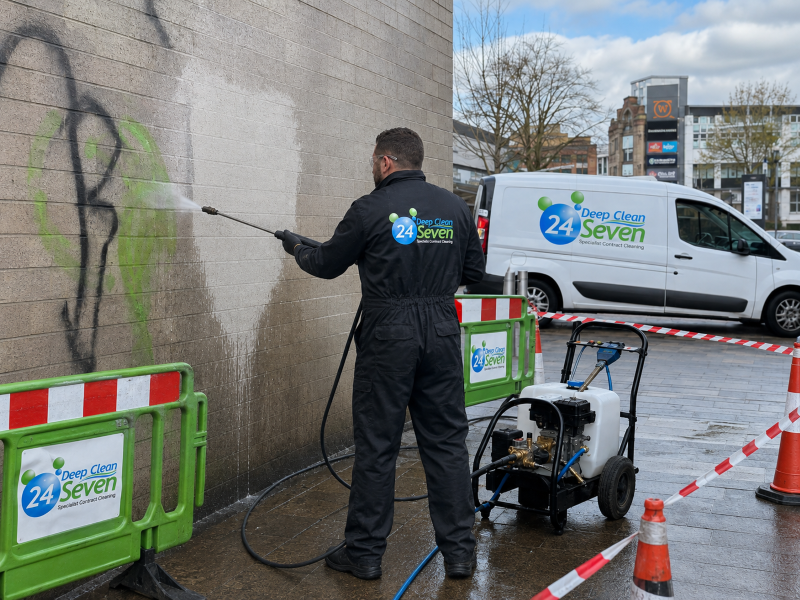
Graffiti can quickly alter how customers, tenants and local communities perceive a retail park, commercial estate or public-facing building. A marked entrance, service wall, pedestrian route or shopfront may make an otherwise well-managed property appear neglected. The problem can become more complicated when paint or marker ink has penetrated porous brickwork, historic stone, render, coated cladding or other sensitive materials. For facilities managers, building managers and estates teams, appointing professional graffiti removal contractors is not simply a matter of finding someone with a pressure washer. The contractor must identify the surface and graffiti type, select a suitable removal method, protect nearby users and control any chemicals, water or residue produced during the work.
This FAQ guide explains what facilities teams should consider when arranging graffiti removal across retail parks, hospitality venues, civic spaces, education estates and other publicly visible commercial sites.
Quick answer: what do graffiti removal contractors do?
Professional graffiti removal contractors assess unwanted paint, ink and surface markings before choosing a removal technique suited to the affected material.
Depending on the site and substrate, the work may involve:
- Specialist graffiti-removal products
- Hot-water cleaning
- Controlled pressure washing
- Low-pressure rinsing
- DOFF cleaning
- Manual application and agitation
- Repeated treatments
- Shadow and staining reduction
- Protective coating assessment
- Wastewater and residue control
The aim is to remove as much graffiti as practicably possible without causing avoidable damage to the original surface.
Historic England advises that specialist contractors should understand the different types of graffiti and building material involved, rather than relying on one aggressive method for every surface.
Why does prompt graffiti removal matter at retail parks?
Retail parks and public-facing commercial sites rely heavily on appearance, accessibility and customer confidence.
Graffiti may affect:
- Building entrances
- External shopfronts
- Service corridors
- Pedestrian routes
- Car parks
- Bin stores
- Boundary walls
- Delivery areas
- Public seating
- Signage surrounds
- Underpasses and stairwells
Prompt action can help restore the appearance of the site before the marking becomes an established part of the surrounding environment. It also allows the facilities team to inspect the surface for damage, staining or coating failure that may have been hidden by the graffiti.
Some councils prioritise offensive, racist or hate-related graffiti for rapid removal, while ordinary graffiti may be handled through different service timescales. The exact responsibilities also vary according to whether the affected surface is publicly or privately owned.
Are councils responsible for removing graffiti from commercial property?
Not usually in every circumstance.
UK Government sources state that local councils are generally responsible for removing graffiti from assets such as public buildings, monuments, benches and bins. Graffiti on privately owned commercial premises is often the responsibility of the property owner or occupier, although some councils offer additional removal services or local schemes.
Facilities managers should check:
- Who owns the affected wall or structure
- Whether it forms part of adopted highway land
- Whether it belongs to a tenant or landlord
- Whether the local authority offers a removal scheme
- Whether consent is needed from the property owner
- Whether the graffiti should be reported to the police
- Whether offensive content requires an urgent response
Where the site is privately managed, appointing commercial graffiti removal contractors may provide greater control over timescales, access, reporting and the removal method used.
Should graffiti be photographed before it is removed?
Yes. Photographic records are useful before any cleaning begins.
Facilities teams should consider recording:
- The overall location
- Close-up images of the graffiti
- The date it was discovered
- The approximate size
- The affected surface
- Nearby damage
- Any offensive or threatening content
- Evidence of forced access or vandalism
- Previous graffiti in the same area
The record may be useful for internal reporting, insurance discussions, police reports, contractor instructions or reviewing repeated incidents.
Once the required evidence has been retained and any reporting procedures have been followed, prompt removal can be arranged.
How do graffiti removal contractors choose the correct method?
Competent graffiti removal contractors begin with the surface rather than the cleaning machine.
The assessment should consider:
- Whether the substrate is porous or non-porous
- The age and condition of the surface
- The type of paint, marker or coating
- How long the graffiti has been present
- Whether previous cleaning has altered the surface
- The presence of cracks, open joints or weak finishes
- Whether the wall is listed or historically significant
- Access restrictions
- Drainage and wastewater routes
- Nearby pedestrians, vehicles and landscaping
A small test area may be advisable before the full treatment begins, particularly where stone, brick, render, coatings or historic materials could be affected.
Historic preservation bodies in the UK advise the importance of identifying both the graffiti material and the underlying substrate before selecting a cleaning technique.
Can all graffiti be removed completely?
Not always.
The final result depends on the relationship between the graffiti and the substrate. Paint may sit on the surface of glazed tiles or metal, while it may penetrate deeply into porous brick, sandstone or unsealed concrete.
Complete removal may be more difficult where:
- The paint has entered open pores
- The surface is weathered
- Several layers of graffiti are present
- Previous removal attempts have spread the pigment
- Harsh cleaning has damaged the surface
- The graffiti has remained in place for a long time
- The substrate contains existing staining
- A protective coating has failed unevenly
Professional graffiti removal contractors should explain the likely outcome before work begins. In some cases, several controlled treatments will produce a safer result than one aggressive attempt.
Why is ordinary pressure washing not always suitable?
Pressure washing can be effective on robust surfaces, but excessive pressure may damage weaker masonry, pointing, coatings or rendered finishes.
Possible damage can include:
- Surface erosion
- Loss of mortar
- Etching
- Colour variation
- Water penetration
- Damage around joints
- Paint spreading
- A visible clean patch or “halo”
For this reason, the contractor should adjust the water pressure, temperature, nozzle, distance and cleaning product to suit the material.
Historic or delicate substrates may require a lower-pressure technique or Doff cleaning rather than conventional high-pressure washing. Historic preservation bodies in the UK recommend a cautious, material-specific approach to graffiti removal from older buildings.
What is Doff cleaning, and can it remove graffiti?
Doff cleaning is a specialist system that uses superheated water delivered at relatively low pressure.
It can be suitable for some masonry and building surfaces where controlled heat can help loosen paint, biological growth and other contamination without relying on highly aggressive mechanical pressure.
Whether Doff cleaning is appropriate depends on:
- The graffiti material
- The depth of penetration
- The type of brick or stone
- The condition of the pointing
- Previous coatings
- The age and significance of the building
- The desired finish
A survey or test area should confirm whether Doff cleaning is suitable. It should not be assumed that one method will remove every paint type from every surface.
Deep Clean 24 Seven can assess whether pressure washing, Doff cleaning or another specialist process is appropriate for the affected area.
Can graffiti removal damage brickwork?
Yes, if the wrong method is used.
Older and softer bricks can lose their surface when exposed to excessive pressure or aggressive abrasion. Damaged pointing may also wash out, allowing moisture to enter the wall.
Chemical products can leave staining or alter the appearance of some materials if they are incorrectly selected, mixed, applied or neutralised.
Before cleaning brickwork, graffiti removal contractors should assess:
- Brick hardness and porosity
- Mortar condition
- Existing surface damage
- Paint penetration
- Previous treatments
- Nearby openings and services
- Water run-off
- The feasibility of a discreet test patch
The objective should be to remove the graffiti while retaining as much of the original surface as possible.
Can graffiti be removed from natural stone?
Often, but natural stone requires careful assessment.
Sandstone, limestone, granite and other stones have different levels of porosity and durability. The stone may also contain existing staining, salts, weathering or conservation repairs.
Historic preservation bodies in the UK recommend specialist input for graffiti affecting historic buildings and masonry, particularly where inappropriate cleaning could cause permanent damage.
Facilities teams responsible for listed, historic or architecturally sensitive sites should appoint graffiti removal contractors who understand conservation-led cleaning and can explain the proposed method clearly.
Can graffiti be removed from painted or coated surfaces?
It may be possible, but the removal process can affect the underlying coating.
A graffiti-removal product that dissolves the unwanted paint may also soften or strip the original finish. Even where the graffiti is removed, differences in weathering may leave a visible patch.
The contractor may need to consider:
- The type of original coating
- Its age and condition
- Whether a matching finish is available
- The possibility of repainting a complete panel
- Whether the surface has an anti-graffiti coating
- The effect of solvents on nearby seals and plastics
Testing is particularly important where the appearance of a shopfront, branded wall or cladding panel must remain consistent.
How quickly should graffiti removal contractors attend?
The appropriate response time depends on the location, content and operational effect.
Urgent attendance may be appropriate where graffiti:
- Contains racist, hateful or threatening language
- Is highly offensive
- Affects a prominent customer entrance
- Obscures safety information or signage
- Appears across several connected sites
- Has damaged a heritage asset
- Creates complaints from tenants or the public
- Forms part of wider criminal damage
Other graffiti may be incorporated into a planned site visit or multi-area cleaning programme.
Facilities teams should agree service priorities in advance, especially where a retail or property portfolio contains several public-facing locations.
Can graffiti removal be completed while a site remains open?
Often, yes, provided the work is properly planned.
Retail parks, commercial buildings and civic areas may remain operational while defined sections are cleaned. However, the contractor may need to establish a temporary exclusion zone around the work.
The plan should consider:
- Pedestrian diversions
- Vehicle movements
- Trading hours
- Customer entrances
- Nearby shopfronts
- Wind and overspray
- Noise
- Trailing hoses
- Chemical application
- Drainage
- Drying or dwell times
- Reopening checks
Out-of-hours or early-morning working may be appropriate where the affected area experiences heavy daytime footfall.
Deep Clean 24 Seven offers flexible scheduling so graffiti-removal work can be planned around tenants, customers and site operations.
What health and safety information should contractors provide?
Commercial graffiti removal contractors should be able to provide a suitable package of site-specific safety information.
This may include:
- Risk assessments
- Method statements
- COSHH assessments
- Safety data sheets
- Equipment details
- Pedestrian-control arrangements
- PPE requirements
- Wastewater controls
- Access plans
- Emergency arrangements
- Public liability insurance information
UK guidance states that COSHH requires employers to assess, manage and monitor exposure to chemicals and other substances that may harm health. Where hazardous cleaning products are used, the contractor must select and apply suitable controls rather than relying only on the product label.
Why does COSHH matter during graffiti removal?
Some graffiti-removal products contain solvents, irritants or corrosive ingredients. Aerosols, splashes and skin contact may expose the operative or people nearby.
A COSHH assessment should consider:
- The product being used
- The method of application
- Ventilation
- The size of the area
- Duration of exposure
- Potential skin or eye contact
- Overspray
- Nearby site users
- Storage and transport
- Spill response
- Disposal
Employers are expected to prevent exposure where possible or adequately control it, including considering whether a less hazardous substance or safer application method could be used.
How should wastewater and chemical residue be managed?
The method should be planned before the work starts.
Graffiti removal may produce:
- Paint residue
- Dirty water
- Chemical residue
- Loose coating material
- Contaminated absorbent products
- Debris from the affected surface
The contractor should identify where water will flow and prevent uncontrolled discharge into entrances, planted areas or inappropriate drainage points.
The necessary controls will vary by product, volume and location. They may include controlled collection, absorbent materials, temporary drainage protection or specialist disposal.
Facilities managers should ask graffiti removal contractors how they will contain residue as part of the quotation and method statement.
Can removal work reveal defects in the building surface?
Yes. Once graffiti and surface dirt have been removed, the contractor may uncover:
- Cracked render
- Failed pointing
- Loose coatings
- Open joints
- Historic repairs
- Impact damage
- Water staining
- Corrosion
- Previously concealed vandalism
These defects may require repair by an appropriate building contractor. They should be photographed and reported rather than concealed within the completion documentation.
Graffiti removal can therefore support a wider building-condition review, particularly on frequently targeted walls and service areas.
Should anti-graffiti coatings be applied after cleaning?
An anti-graffiti coating may be useful on repeatedly targeted surfaces, but it should not be applied automatically.
The decision should take account of:
- The substrate
- The visual finish
- Breathability
- Heritage status
- Previous coating history
- Exposure to weather
- Likely future cleaning methods
- Maintenance requirements
Some coatings are designed to remain in place through repeated cleaning. Others are sacrificial and must be renewed after graffiti removal.
On historic or porous masonry, an unsuitable coating may alter the appearance or affect moisture movement. Specialist advice and a test area may be necessary.
How can retail parks discourage repeat graffiti?
Cleaning is one part of a broader site-management approach.
Facilities teams may also review:
- Lighting
- CCTV coverage
- Natural surveillance
- Boundary security
- Overgrown landscaping
- Unused corners and service routes
- Ease of access to roofs or rear walls
- Response times
- Communication with tenants
- Protective coating suitability
- Local reporting arrangements
Some councils recommend measures such as improved lighting and natural surveillance as part of graffiti prevention.
No measure can guarantee that graffiti will not return, but prompt reporting, removal and site review can form a coordinated response.
What should facilities managers include in the quotation request?
A clear brief helps graffiti removal contractors provide an accurate scope and price.
The request should include:
- The full site address
- Photographs
- Approximate dimensions
- Surface type
- Location and access information
- Operating hours
- Parking or permit restrictions
- Whether the site is listed or historic
- Required response time
- Water and power availability
- Pedestrian or traffic concerns
- Reporting requirements
- Whether a test patch is needed
- Whether protective coatings should be considered
For portfolios, include a site list and explain whether the work is reactive, scheduled or part of a framework arrangement.
What should a completed graffiti-removal report include?
Completion records can help estates teams demonstrate what work was undertaken and identify further maintenance needs.
A useful report may contain:
- Date and location
- Scope of work
- Surface type
- Removal method
- Products used
- Before-and-after photographs
- Areas treated
- Limitations
- Residual staining
- Defects discovered
- Recommended repairs
- Protective-coating advice
- Waste or residue controls
- Operative details
Where complete removal was not achievable without risking surface damage, this should be stated clearly.
Can several services be combined during one visit?
Yes. Combining related exterior-cleaning services may reduce repeated mobilisation and site disruption.
Subject to the survey and scope, a visit may incorporate:
- Graffiti removal
- Pressure washing
- Doff cleaning
- Paving cleaning
- Entrance cleaning
- Wall and façade cleaning
- High-level cleaning
- Condition photography
Treating several affected areas together can be particularly helpful for retail parks, hospitality venues, schools, managed estates and public-sector sites.
How can graffiti removal support a site’s reputation?
A public-facing property communicates its management standards before a visitor enters the building.
Clean walls, entrances and pedestrian areas help create a more orderly and professional appearance. By contrast, unmanaged graffiti may contribute to tenant concerns, customer complaints and a wider perception that maintenance is being overlooked.
Professional graffiti removal contractors help facilities teams respond consistently, choose methods suited to the building and maintain clearer records of the action taken.
Graffiti removal should sit alongside routine inspections, planned exterior cleaning, repairs and broader estate-management procedures.
Why Choose Deep Clean 24 Seven?
Deep Clean 24 Seven provides specialist cleaning services for commercial and public-facing properties across the UK.
Our services include:
- Graffiti removal
- Graffiti cleaning
- Pressure washing
- Doff cleaning
- Commercial kitchen deep cleaning
- High-level cleaning
Our specialist teams tailor the method to the surface, location, operating environment and desired result.
We provide:
- UK-wide service coverage
- Flexible scheduling
- 24/7 operational support
- Free site surveys
- Photographic evidence
- Tailored single-site and multi-site programmes
- Customer-focused project coordination
Arrange Your Survey
Graffiti removal should begin with an accurate assessment of the surface rather than an aggressive cleaning method.
A site survey can help establish:
- The type and extent of the graffiti
- The material affected
- The safest removal approach
- Whether a test area is required
- How the area should be segregated
- Whether pressure washing or Doff cleaning is appropriate
- Whether other exterior-cleaning work can be combined
Contact the Deep Clean 24 Seven Operations Team for expert advice and to discuss urgent graffiti removal, recurring vandalism or a planned cleaning programme.
📞 Call our Operations Team to discuss your requirements: 0203 640 8247
📧 Email: info@24sevengroup.co.uk
Follow these useful website links to find out more about the services we offer: Kitchen Deep Cleaning; Pressure Washing; DOFF Cleaning, Graffiti Removal.
Follow us on Instagram, Facebook and Linked In.