
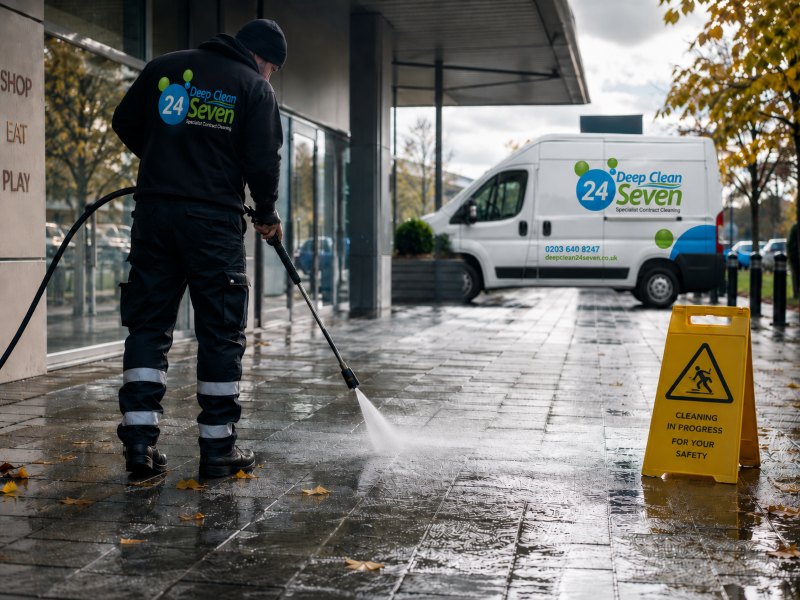
Autumn leaves, moss, algae and ingrained surface contamination can make commercial walkways increasingly difficult to manage as temperatures fall. What appears to be a minor cleanliness problem in September or October may become a more serious health and safety concern once paths remain wet for longer and overnight temperatures begin to reach freezing point. For facilities managers, retail park operators and council officers, professional pressure washing should therefore be considered more than a cosmetic service. When planned before winter, it can form part of a wider programme for reducing surface contamination, improving pedestrian routes and preparing high-footfall areas for frost, ice and severe weather.
This FAQ guide explains why a professional pressure washing service can help, which areas should be prioritised and why autumn is usually the best time to arrange a commercial site survey.
Quick answer: why is professional pressure washing important before winter?
Professional pressure washing removes algae, moss, wet leaf residue, dirt and other contamination that can reduce the grip available on external surfaces.
This is particularly important before winter because contaminated pathways may remain wet for longer. When temperatures fall, retained moisture can freeze and add another hazard to a surface that may already be slippery.
The Health and Safety Executive notes that slip accidents increase during autumn and winter because leaves become wet and slippery, daylight reduces and ice or snow can build up on paths. It advises organisations to address regularly used walkways promptly and identify outdoor areas most likely to be affected.
Professional pressure washing does not replace gritting, weather monitoring or access restrictions. Instead, it helps remove the underlying contamination before cold weather arrives, giving facilities teams a cleaner surface on which to carry out their winter maintenance procedures.
Why does minor autumn algae become a serious winter risk?
Algae can begin as a thin green or dark film that is easy to overlook during routine inspections. Moss may initially appear only along shaded edges, joints, drainage channels or sections of paving that receive little direct sunlight.
These organic deposits can retain moisture and combine with dirt, fallen leaves and atmospheric contamination. As surfaces remain damp, the available grip underfoot may decline.
When temperatures fall below freezing, moisture held within or around the contamination can freeze. The result may be a hard-to-see layer of ice over an already compromised surface.
The risk is not limited to visibly overgrown paving. Thin biological films can blend into concrete, tarmac and block paving, particularly in poor winter light. HSE guidance states that contamination is involved in almost all slip accidents and that even a small amount of contamination can create a significant problem on some surfaces.
Does rock salt remove algae and moss from pathways?
No. Rock salt can help prevent ice forming and encourage existing ice or snow to melt, but it does not deep-clean algae, moss or ingrained organic residue from the surface.
HSE recommends gritting when frost, ice or snow is forecast, particularly where walkways are damp and surface temperatures are at or below freezing. It also explains that salt does not work instantly and needs time to dissolve into moisture.
Gritting and professional pressure washing therefore perform different functions.
Professional pressure washing addresses established surface contamination.
Gritting helps manage the immediate risk of frost, snow and ice.
Weather monitoring helps facilities teams decide when winter controls must be activated.
Barriers, diversions and warning measures help manage access when a route cannot be kept safe.
A well-managed site may require all four measures at different stages of the winter season.
Why can gritting be less effective on heavily contaminated surfaces?
Grit can still assist with ice management, but it does not restore the original condition of a pathway that is covered in moss, algae, compacted leaves or oily residue.
Where contamination remains, pedestrians may continue to encounter a slippery surface even after visible ice has melted. Loose organic material can also make it harder to inspect the underlying paving and identify cracks, uneven blocks or drainage problems.
Professional pressure washing removes the contaminating layer at its source. This allows facilities teams to assess the actual condition of the surface and apply their winter controls to cleaner pedestrian routes.
The objective is not to replace gritting. It is to prevent winter maintenance teams from relying on grit alone to manage a surface that already presents a separate contamination risk.
Is professional pressure washing legally required?
There is no general law stating that every commercial path must be pressure washed at a particular interval. However, employers and people controlling premises must assess foreseeable risks and take appropriate precautions.
The Management of Health and Safety at Work Regulations 1999 require employers to carry out a suitable and sufficient assessment of risks to employees and others who may be affected by their work.
The Workplace (Health, Safety and Welfare) Regulations 1992 also require workplace floors and traffic routes to be kept free from obstructions and substances that may cause a person to slip, trip or fall.
HSE guidance explains that employers should manage slip and trip risks through suitable cleaning, maintenance, risk assessment and monitoring. The appropriate control will depend on the site, its users, the surface and the nature of the contamination.
Professional pressure washing may therefore be a reasonably practicable control where algae, moss and ingrained dirt are contributing to a foreseeable slip risk.
How can professional pressure washing help reduce injury claims?
Professional pressure washing can help an organisation demonstrate that it identified a developing hazard and took preventive action before winter.
Removing contamination may reduce the likelihood of a slip, but the service also gives facilities teams an opportunity to document:
- The condition of the area before cleaning
- The contamination that was present
- The date on which work was completed
- The cleaning method used
- The areas included within the scope
- Any defects discovered beneath the contamination
- Recommended repairs or further controls
- The condition of the surface after cleaning
These records can form part of a broader winter maintenance file alongside risk assessments, inspection logs, weather monitoring, gritting schedules and reports of remedial work.
In England and Wales, occupiers owe lawful visitors a common duty of care under the Occupiers’ Liability Act 1957. The duty is to take reasonable care in the circumstances to see that visitors are reasonably safe while using the premises for the permitted purpose.
Professional pressure washing cannot guarantee that an accident or claim will never occur. However, a documented programme of inspections, cleaning and winter controls may help show that the organisation took foreseeable risks seriously rather than waiting for an incident.
Different legal principles may apply according to the location, circumstances and status of the person using the site. Organisations should obtain specific legal advice where a claim or serious incident has occurred.
Does professional pressure washing protect against public liability claims?
It can help reduce the underlying risk that may lead to a claim, but it should not be presented as complete legal protection.
A claimant may consider a range of factors, including:
- Whether the danger was foreseeable
- How long the hazard had been present
- Whether inspections were carried out
- Whether previous concerns had been reported
- What cleaning and maintenance procedures were in place
- Whether severe weather had been forecast
- Whether routes had been gritted, closed or diverted
- Whether warning measures were appropriate
- Whether maintenance records were retained
A clean surface alone will not demonstrate that every reasonable step was taken. Likewise, an accident does not automatically mean that a council, landlord or business was negligent.
The strongest approach is a coordinated winter maintenance system that combines professional pressure washing, condition inspections, drainage checks, weather monitoring, gritting and prompt responses to reported hazards.
Which areas should be prioritised for professional pressure washing?
High-footfall and vulnerable access areas should normally receive the earliest attention.
HSE recommends identifying outdoor areas most likely to be affected by ice, including entrances, car parks, pedestrian walkways, shortcuts, slopes and locations that remain shaded or wet.
Priority areas may include:
Building entrances
Entrances experience concentrated pedestrian traffic and may receive water from rain, footwear and nearby drainage. They should be assessed together with entrance mats, canopies, thresholds and internal flooring.
External steps
A loss of footing on steps may cause a more serious fall than a slip on level ground. Treads, nosings, landings and handrail approaches should remain visible and free from organic build-up.
Disabled access ramps
Ramps need particular attention because the gradient can increase the consequences of reduced surface grip. Cleaning should cover the full route, including turning areas, landings and connections with car parks or pavements.
Public footpaths and estate walkways
Routes between buildings, car parks, residential blocks and public spaces may develop algae in shaded or poorly drained sections. Informal shortcuts should also be considered where people use them regularly.
Civic squares and pedestrianised areas
Large public spaces may include different paving materials, joints, street furniture, planters and drainage channels. Cleaning plans should reflect pedestrian volumes and any events scheduled for the area.
Retail park walkways
Retail parks often combine pedestrian routes with vehicle movements, trolley areas and service roads. Routes between parking bays, crossings and shop entrances should receive close attention.
Loading bays and service yards
These areas may contain dirt, tyre residue, food waste, packaging debris or oily contamination. Pedestrian routes should be identified clearly and cleaned using a method suitable for the surface and contaminant.
Public transport drop-off points
Bus stops, taxi areas, collection points and pedestrian waiting zones can experience intense footfall. Facilities teams should review the route from the drop-off point to the main entrance, rather than treating each area separately.
Bin stores and waste collection routes
Organic residue, leaking waste and poor drainage can create localised contamination. These areas may also be used early in the morning when frost is most likely to remain.
Shaded north-facing paths
Areas that receive limited sunlight often stay damp for longer. Moss and algae may return more quickly, making these routes suitable for more frequent inspections.
Should concrete, tarmac and block paving be cleaned differently?
Yes. Professional pressure washing should be adjusted to the construction, age and condition of the surface.
Concrete
Concrete is generally robust, but damaged joints, cracks and weakened edges require care. Cleaning can also reveal defects previously concealed by dirt or algae.
Tarmac
Older or deteriorating tarmac may be damaged by excessive pressure or an unsuitable nozzle. The operative should assess the surface before selecting an appropriate cleaning method.
Block paving
Block paving requires attention to joints, loose blocks, settlement and drainage. Excessive cleaning may disturb jointing material, so the scope should account for any reinstatement required after the work.
Natural stone
Different stone types respond differently to pressure, cleaning products and water. A trial area may be appropriate before the full surface is treated.
Resin-bound and specialist surfaces
These surfaces should be cleaned in accordance with their condition and any relevant manufacturer guidance. Aggressive pressure may not be suitable.
Professional pressure washing is not simply a matter of applying maximum pressure. The operator should select a suitable combination of equipment, nozzle, working distance, water flow and cleaning method for the surface.
Can pressure washing create its own temporary slip risk?
Yes. Water and loosened debris can create a temporary risk while cleaning is taking place and while the surface dries.
Cleaning is an important method for controlling contamination, but the cleaning process can introduce hazards such as wet floors and equipment in pedestrian areas. It is recommended that cleaning happens during quieter periods, restricting access and keeping pedestrians away until surfaces are safe.
A professional pressure washing plan should therefore consider:
- Pedestrian segregation
- Barriers and signage
- Alternative routes
- Working hours
- Water run-off
- Drainage points
- Trailing hoses
- Vehicle movements
- Weather conditions
- Drying time
- Reopening checks
For retail parks, civic spaces and public walkways, out-of-hours or phased working may reduce disruption while allowing safe access to be maintained.
When is the best time to arrange professional pressure washing?
Late summer and autumn are often suitable times to inspect and clean external pedestrian areas before prolonged wet weather and freezing temperatures.
Booking early gives facilities teams time to:
- Survey multiple areas
- Agree priorities
- Arrange access
- Notify tenants or site users
- Schedule out-of-hours work
- Complete repairs discovered during cleaning
- Review drainage problems
- Update winter risk assessments
- Coordinate gritting and weather-response plans
Waiting until the first severe frost may limit available working windows and leave little time to address damaged paving or blocked drainage uncovered during cleaning.
Professional pressure washing should ideally be completed while weather conditions allow surfaces to be cleaned safely and pedestrian areas can dry properly.
How frequently should commercial pathways be pressure washed?
There is no universal cleaning interval for every commercial site.
The correct frequency depends on:
- Footfall levels
- The amount of shade
- Nearby trees and planting
- Drainage performance
- Surface texture
- Local weather exposure
- Vehicle movements
- Food or waste contamination
- Previous algae and moss growth
- The site’s inspection history
A busy retail park entrance may need attention more frequently than an exposed walkway that dries quickly. A shaded council path beside mature trees may require seasonal cleaning and closer autumn monitoring.
Facilities managers should use inspections to determine whether cleaning is required instead of relying only on an arbitrary annual date.
What should be included in a professional pressure washing site survey?
A site survey should establish more than the approximate number of square metres requiring cleaning.
The survey should consider:
- Surface types and condition
- Pedestrian and vehicle movements
- Priority access routes
- Visible algae, moss and staining
- Slopes, steps and ramps
- Drainage and water run-off
- Nearby doors and electrical equipment
- Areas requiring segregation
- Suitable working times
- Water access
- Sensitive surrounding materials
- Potential repair requirements
- The need for a test area
- The required photographic evidence
The survey can then be used to produce a clear scope of work and identify which areas should be completed before lower-priority cosmetic cleaning.
What records should facilities managers retain?
Cleaning and maintenance records help demonstrate how a site manages foreseeable risks.
A useful professional pressure washing record may include:
- The survey date
- The areas inspected
- Before photographs
- The agreed scope
- Risk assessments and method statements
- The cleaning date
- The surface-cleaning method
- Any areas excluded from the work
- Defects identified
- Recommendations issued
- After photographs
- The name of the responsible contractor
- The next review date
These documents should sit alongside the site’s winter inspection, gritting and incident-reporting records.
HSE advises employers to organise responsibility for problem areas, monitor whether controls are working and retain records of cleaning and maintenance work.
Is professional pressure washing only necessary when surfaces look dirty?
No. Visual appearance is useful, but it should not be the only consideration.
Some contamination is obvious, particularly where thick moss or green algae has developed. Other deposits may appear only as darkened paving, compacted residue or a thin film that becomes noticeable when wet.
A site can look generally presentable while still containing localised slip risks around drainage channels, shaded entrances, ramps or path edges.
The purpose of a professional survey is to assess how the surface behaves and where contamination is developing, not simply whether it looks untidy from a distance.
Can professional pressure washing improve more than winter safety?
Yes. Removing contamination can also make it easier to inspect the condition of external assets.
Once dirt, moss and residue have been removed, facilities teams may be better able to identify:
- Cracked paving
- Loose blocks
- Damaged step edges
- Failed pointing
- Standing-water locations
- Blocked drainage channels
- Surface deterioration
- Uneven transitions
- Worn line markings
These findings can be incorporated into planned maintenance rather than being left until they contribute to an accident, complaint or emergency repair.
The primary focus of the winter programme should remain risk reduction, but improved presentation and easier condition monitoring are useful additional outcomes.
What should happen after professional pressure washing?
The site should be checked before pedestrian areas are fully reopened.
The post-cleaning review should confirm:
- Loose debris has been removed
- Water has drained or dried
- Barriers can be removed safely
- No new trip hazards have been exposed
- Drainage channels are clear
- Any damaged areas have been recorded
- Priority repairs have been raised
- Photographic evidence has been completed
The winter maintenance plan should then continue through regular inspections, weather monitoring and gritting whenever frost, ice or snow is forecast.
Professional pressure washing is a preventive stage within the programme, not the final action required throughout winter.
Professional pressure washing for high-footfall commercial sites
Deep Clean 24 Seven provides professional pressure washing for commercial properties, retail parks, public areas, managed estates and other high-footfall environments.
Our operations team can assess external surfaces, identify priority access routes and plan work around site users, tenants, deliveries and public access.
A free site survey can help facilities managers and council teams establish:
- Which pathways need urgent attention
- Which surfaces require a tailored cleaning method
- How work can be phased safely
- Where out-of-hours access may be beneficial
- Which defects should be referred for repair
- What photographic records will be provided
Book a free professional pressure washing site survey before winter
Winter maintenance calendars can fill rapidly as facilities teams, landlords and public-sector organisations prepare for wet weather, frost and ice.
Booking a free site survey during autumn gives your organisation more time to assess high-risk routes, agree the scope of work and secure a suitable place within the maintenance schedule before severe weather arrives.
To discuss professional pressure washing for a commercial site, retail park, public pathway or a managed estate:
📞 Call our Operations Team to discuss your requirements: 0203 640 8247
📧 Email: info@24sevengroup.co.uk
Follow these useful website links to find out more about the services we offer: Kitchen Deep Cleaning; Pressure Washing; Doff Cleaning, Graffiti Removal.
Follow us on Instagram, Facebook and Linked In.
This article provides general information about external cleaning and winter slip-risk management. Each site should be assessed according to its surfaces, users, location and specific legal responsibilities.